

Ask the Stone Dr - Sealing My Stone?

Sealing My Stone?

The Importance of Sealing Your Stone

Sealing your stone is like changing the batteries in your smoke detector, everyone knows they really should do it, but forgets to get it done regularly.  Ok---maybe you do not risk death but your stone does risk permanent unsightly staining.  Sealing your stone is like buying insurance before the accident.  A little prevention can save you considerable amounts down the road.

Here are a few common questions and answers to consider about sealing your stone.

Why do we seal stone and grout?

Stone is naturally porous, some more than others.  If you have every wet an unsealed concrete driveway or sidewalk you have seen how liquids can soak into a stone like surface.  Any liquid spilled on an unsealed stone will slowly seep into the stone, unless the stone has been sealed or "resinated".  If the liquid is colored, can chemically interact with the stone or a trace element within the stone, or has the potential to attract dirt, it has the potential to stain your stone.  By sealing the stone you effectively seal these pores preventing the spill or liquid from soaking into the stone and forcing it to remain on the surface where it can be cleaned up and removed from the stone.

What frequency should your stone be sealed?

Stone sealers will breakdown in the presence of natural UV light or when cleaned with harsh cleansers.  As the sealer is removed or breaks down so does your stone’s stain protection.  For this reason it is recommended that you re-seal your stone, tile and grout surfaces at least every 2-years, and more frequently in areas of high sunlight or wear.

What might happen if the stone is NOT sealed?

If not sealed, and the stone becomes stained, you are faced with either replacing the stone or an expensive time consuming effort to remove the stain with no guarantee of success.  Stain removal is one of the only services that most stone craftsman will NOT guarantee.  In order to remove a stain, one must identify and prepare a chemical cocktail designed to dissolve the invading spill material.  This chemical cocktail is applied via a poultice.  The poultice must be left in place overnight.  If the cocktail prepared was appropriately selected, it will begin to draw out the stain.  This process may have to be repeated one to three times and in some cases as many as 10 times before the stain is completely removed.  While the poultice is down this surface cannot be used, as such one may lose the use of a counter or floor area for several days.  Further in many cases, the chemical cocktail includes aggressive solvents or odorous chemicals.  Some chemicals may even damage the stone; requiring restoration after the stain is removed to return the stone’s original finish.

Stain removal can be quite expensive if done by a trained craftsman due to the numerous trips required to set-up and then remove-and-clean the effected area.  Expect to pay several times the cost of sealing should you encounter a broad area stain problem.

The only good news is that stain removal is something that can be done by the homeowner with appropriate guidance.  MARBLELIFE promotes a stain removal guide for just this purpose.

What are the costs and risks associated with stain removal?

The greatest risk is that unless you know the source of the stain, it can be very difficult to define the appropriate concoction to remove the stain.

Some of the stain removal chemical's vapors are strong enough to remove paint or the finish off wood in the area. 

Costs will vary depending on the number of treatments required, cost of materials, and area affected.  What is clear is that this is an area where with the appropriate guidance the stone owner can do themselves more cost effectively than having a craftsman perform this service.  You are better served to have a craftsman periodically seal your stone.

Should I remove the stain or replace the tile?

If you have replacement tiles from the same lot, it will actually be easier and less expensive in many cases to replace the tile, with confidence that the tile will blend with the tile on your floor presently.  If you do NOT have replacement tile from the same lot, you will find that even though you have purchased the some type of stone, and perhaps even gotten it from the same quarry, the color will likely be off subtly.  Not enough of a difference to notice in the store, but once the tile is placed on the floor you will be able to pick it out. 

If you cannot remove the stain, replacing the tile may prove to be a cost effective option.

Will sealing prevent all stains?

No. 

Sealing buys you substantially more time to clean up a spill before a stain occurs.  If you spill oil on a sealed floor and leave it over the weekend it may still slowly penetrate the seal.  Oil on an unsealed surface will stain. 

Stains may also be caused by situations behind or beneath the tile.  If you have nail that is trapped in the mortar that starts to rust it will stain the stone from the backside.

Most stains are caused from top-side spills.  Sealing addressing these type situations very well.

What do I do if I already have a stain?

You have a decision to make.  If the stain is a concern then you will want to remove the stain BEFORE sealing the floor.  If you seal the floor with the stain in place it will be there forever sealed into the stone.

What is the difference between a solvent-borne and water-borne sealer?

The actual sealing chemistry is a moisture curable product that is delivered in either a water or solvent carrier.  The carrier is designed to evaporate away leaving the sealing compound to cure and seal the pores.  Both product types can work, the difference is in the ease of application.  Solvent borne products can be applied in a quick wipe-on/wipe-off manner.  Waterborne products can require more care in removal of the excess.  If the excess material is not removed it will bond to the top of your stone and create a dulling or hazy film appearance.  Unfortunately, once this has occurred you will need a professional craftsman to remove and re-apply the sealant.

Do I want a topical or penetrating (impregnating) sealer?

If you are happy with the appearance of your UN-sealed stone you want a penetrating sealer which is designed to seal the pores without altering or impacting the appearance of your stone or tile surface. 

A topical sealer is most often employed when one is seeking to alter some aspect of the stone, tile or grout’s appearance.  Topical grout sealers such as

·      MARBLELIFE COLORSeal is employed to restore or alter the color of sanded grout.

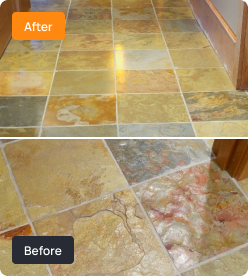
·      MARBLELIFE Interlok is employed to seal slate while also enriching the color, providing a semi-gloss or a gloss appearance.

·      MARBLELIFE Stone Enhancer is designed to enhance granite or slate color.

In most cases, a penetrating sealer is what you are seeking.

How can I determine whether my stone is sealed?

Most new installations or new construction does NOT include sealing the stone.  This can also prove to be the most overlooked application process, as once done one cannot visually determine whether it was done or not.

The most basic test is to sprinkle some water onto the surface and let it sit for 15 to 30 minutes.  If the stone takes on a darker wet look it is not sealed.  A sealed surface will keep the water beaded up on the surface.

Why do you state "sealed" or "resinated"?  What is "resinated" and how do I know if my stone has been resinated? 

Resination refers to a process whereby a plastic resin (typically a polyester) is vaccuumed THROUGH the stone inorder to enhance the stone's flexibility (reducing its natural brittleness) inorder to make improve its transportability.  You may have noticed a sharp increase in the number of stones that have come to market over the past few years.  The resination process is credited for this developing, allowing many stones that did not travel well to be shipped around the world. 

Why is resination important to our discussion on sealing stone? 

By filling in the stone pores, resination in effect seals the stone.  While not the intent, it is a very attractive and useful by-product.  If your counter has been fabricated in the past five years there is a very good chance that it was resinated, as this process has become mainstream.  How do you tell?  Unfortunately there is no sure fire way of being sure that is non-destructive to a finished counter.  If we were looking at slabs in a fabricator's slab yard you might see residual drip marks along the side of slab or on the underside, however the absense of such marks does not mean the stone was not resinated.  When in doubt seal.  If you know who fabricated your counters ask them.  They can typically provide you guidance on whether stone coming from your stone's quarry are being resinated or not.

Now that you know, if you have any additional questions or want to arrange to get your stone, tile and grout investments protected call your local MARBLELIFE office.


We work where you live with teams serving:

BAHAMAS: Grand Bahamas; Nassua, Bahamas
CANADA: Calgary, Canada; Edmonton, Canada; Vancouver, Canada
GRAND CAYMAN: Grand Cayman, Cayman Islands
INDIA: Mumbia, India
IRELAND: Dublin, Ireland
UAE: Abu Dhabi, UAE; Dubai, UAE

UNITED STATES: Little Rock, AK; Birmingham, AL; Mobile, AL; Scottsdale, AZ; Phoenix, AZ; Beverly Hills, CA; Fresno, CA; Los Angeles, CA; Orange County, CA; San Diego, CA; San Francisco, CA; Denver, CO; Vale, CO; Danbury, CT; Hartford, CT; Chicago, IL; Bradenton, FL; Boca Raton, FL; Clearwater, FL; Destin, FL; Fort Lauderdale, FL; Fort Myers, FL; Jacksonville, FL; Lakeland, FL; Miami, FL; Orlando, FL; Pensacola, FL; Sarasota, FL; St. Petersburg, FL; Tallahassee, FL; Tampa, FL; Atlanta, GA; Macon, GA; Savannah, GA; Honolulu, HI; Witchita, KS; Lexington, KY; Louisville, KY; Baton Rouge, LA; New Orleans, LA; Boston, MA; Plymouth, MA; Baltimore, MD; Augusta, ME; Lewistown, ME; Portland, ME; Ann Arbor, MI; Detroit, MI; Farmington, MI; Farmington Hills, MI; Grand Rapids, MI; Jackson, MI; Lansing, MI; Mackinaw, MI; Marquette MI; Pontiac, MI; Rochester, MI; Southfield, MI; Troy, MI; Faribault, MN; Minneapolis, MN; St. Paul, MN; Raleigh, NC; Concord, NH; Keene, NH; Lebanon, NH; Nashua, NH; Manchester, NH; Portsmouth, NH; Atlantic City, NJ; Hibernia, NJ; Long Valley, NJ; Tom's River, NJ; Trenton, NJ; Las Vegas, NV; Cincinnati, OH; Cleveland, OH; Columbus, OH; Dayton, OH; Toledo, OH; Portland, OR; Allentown, PA; Bethlehem, PA; Easton, PA; Harrisburg, PA; Lehigh Valley, PA; Philadelphia, PA; Pittsburgh, PA; Scranton, PA; Charleston, SC; Hilton Head, SC; Chattanooga, TN; Johnson City, TN; Knoxville, TN; Nashville, TN; Austin, TX; Dallas, TX; Fort Worth, TX; Houston, TX; San Antonio, TX; Salt Lake City, UT; Barre, VT; Burlington, VT; Montpelier, VT; Rutland, VT; Olympia, WA; Seattle, WA; Tacoma WA; GreenBay, WI; Milwaukee, WI; Madison, WI; Shawano, WI; Washington, DC;

CLICK HERE To See work done by YOUR LOCAL office

Have a HOTEL or COMMERCIAL Property? MARBLELIFE can provide service programs for 1 to 100 properties through our network - CLICK HERE for more info.

Need marble restoration, granite restoration or tile and grout cleaning or restoration BUT Don't See Your City - CLICK HERE!
We can still meet your needs.

Home | Service | Products | Ask The Stone Dr. | Our Gallery | Join Our Team | Marblelife The Company | Franchise Opportunities
The Marblelife Warranty | Before & After Photos | Your Nearest Help | Our Rich History | Contact Us | Sitemap | Cases | Cleaners
Popular Items | Care Kits | Polishing | Sealers & Enhancers | Granite Care | Marble & Stone Care | Tile & Grout Care | "Caring For" Books
©2007 MARBLELIFE INC - Site by TSM Studio